
Checking Criminal History in Washington
Start by deciding whether “Washington” means Washington City or Washington County. Look at the badge name, citation heading, incident address, or report number. A Washington City Police response belongs with Washington even though a later jail stay may belong to Washington County. A request sent to the county does not automatically reach the Washington police custodian. This basic check saves time and keeps a Washington report request from landing at the wrong desk.
Use the official channel that matches the stage of the Washington event. Washington police records describe the response and investigation. County booking records describe custody. Court records show the charges that were actually filed and the case outcome. Utah BCI Right of Access offers fingerprint-supported self-review of Utah repository history, but it does not offer a public name search of another person's rap sheet.
- Confirm that Washington City Police, rather than the Sheriff, St. George Police, or Utah Highway Patrol, handled the event.
- Ask Washington City Police for the specific incident report or media components needed.
- Check the Washington City Justice Court route shown on a citation for city-level matters.
- Use Washington County booking and Fifth District Court channels when custody or felony filing moved beyond the city.
- For self-review of statewide repository history, follow Utah BCI Right of Access with identification and fingerprints.
Washington City Records, Not County Records
The Washington city-county naming collision is more than a label problem. Washington City Police creates a police report for an event it investigates. The Washington County Sheriff keeps a different file when a person enters county custody. Utah Courts creates another record if a prosecutor files a case. One Washington name search can therefore lead to several records that describe different stages and have different custodians.
The official Washington City gateway establishes the municipal starting point. The source image below reflects that city identity. It helps distinguish the city government from the similarly named county offices that handle jail, prosecution, and other county functions.
Use the Washington gateway to confirm current department links before making a trip. Washington records, recorder, police, and court functions may follow separate contact routes and calendars.
Washington Police Department Records
The Washington City Police Department is the proper source for its incident, arrest, and investigative reports. A useful request names the event or report number when known, the date and approximate time, the exact location, the people involved, and the part of the file sought. A broad request for every record about a person can be hard to identify and may need to be narrowed.
Report components should be named separately. The written narrative, photographs, property record, dispatch or CAD data, audio, and body-camera video are not one interchangeable item. The requester should state whether inspection or an electronic copy is preferred. Washington may verify identity or authority for protected material, redact nonpublic parts, estimate lawful costs, or ask for a more precise description.
The official department view shown below comes from Washington's police page. That Washington page is the best place to confirm current routing and records-counter details before submission.
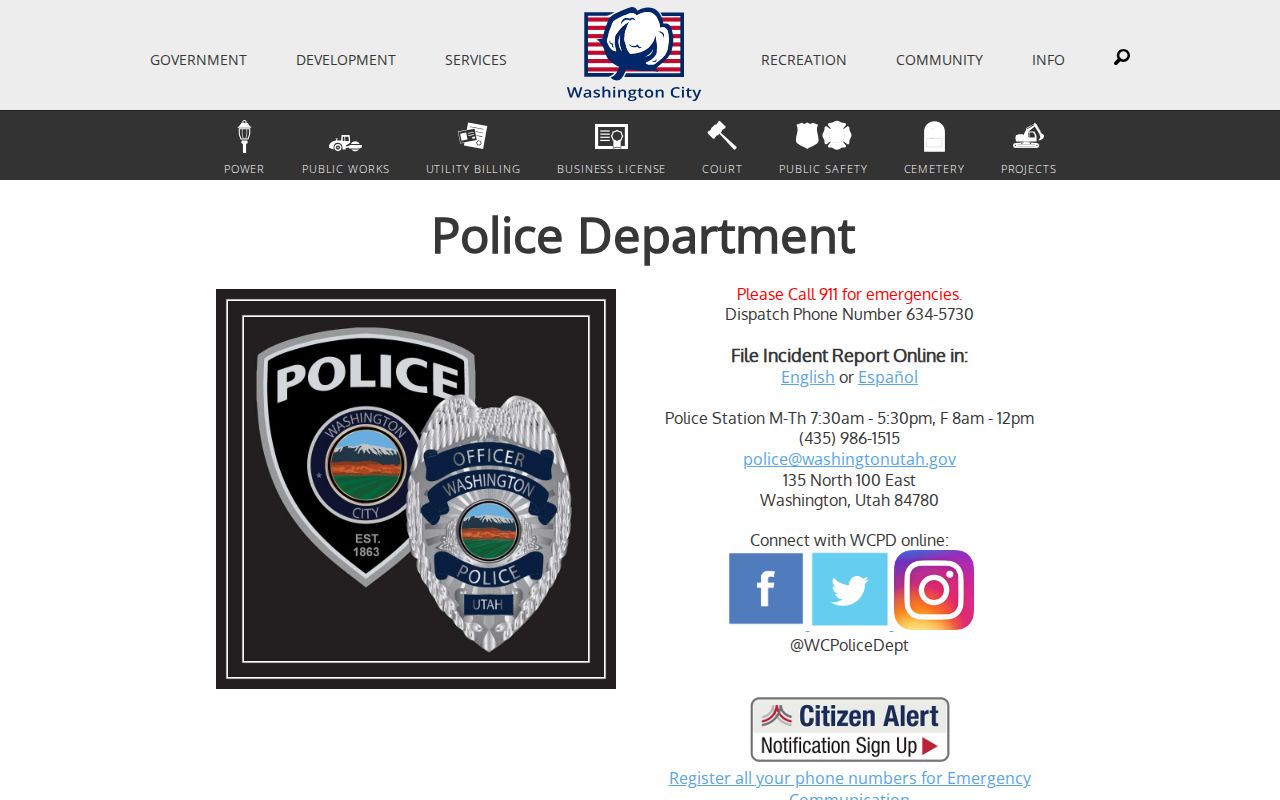
The police page routes requests for Washington-created records. It does not replace the county jail roster or the Utah Courts case system.
Building a Washington Police Record Request
A narrow request gives Washington a clear search task. Keep the Washington incident number, date, location, and agency name from any citation, property receipt, or exchange form. Then list each desired record type. Someone who needs the narrative and dispatch audio should say so; asking only for “the report” may not identify both.
- Incident number
- The police identifier for the event, which is not necessarily a court case number.
- CAD record
- The computer-aided dispatch log documenting call and response activity.
- Segregable portion
- A public part that may be released after protected details are separated or redacted.
- Preferred format
- Inspection, electronic delivery, or copies, subject to the city's available process and lawful fees.
Retain the confirmation and all city replies. They establish what Washington received, how the request was framed, and the basis for any fee, classification, or denial decision. If a request is broad, ask for an estimate before authorizing substantial staff work.
Washington Arrests and Bookings
Washington City does not run a separate long-term county detention system. When Washington police make an arrest that leads to county custody, the local police report stays with Washington while the booking record appears through the Washington County Sheriff and Purgatory Correctional Facility channels. Those Washington records answer different questions. The Washington report addresses the event; the jail entry addresses intake, custody, release, and related booking facts.
A current-custody search can be blank after a release or transfer. That result does not erase the Washington arrest report or a later court case. For older custody history, contact the county jail or request the relevant archived booking material. The broader Washington County arrest lookup explains the county booking channels without turning the city page into a county-wide account.
Booking allegations may also differ from filed charges. A prosecutor can amend, decline, or narrow an officer's initial allegation. Use the court docket for filed counts and the final disposition. An arrest alone is not proof of guilt.
Washington Criminal Records Near I-15
Washington has grown along the I-15 corridor beside St. George. A postal address that says Washington does not always identify the agency that responded. Boundary areas and freeway incidents may involve Washington City Police, St. George Police, the Washington County Sheriff, or Utah Highway Patrol. The arresting-agency field is stronger evidence than the city written in a mailing address.
Check the agency logo, officer name or unit, citation heading, and incident number prefix. If the location alone is uncertain, call Washington police and give the exact street or mile point. The same rule applies to Washington court routing: follow the court printed on a citation rather than assuming all Washington criminal records belong in one city docket.
Municipal Court Records in Washington
Washington City Justice Court handles matters within Utah justice-court jurisdiction that are assigned there, including city and state-law matters at the lower level. Felony cases and class A misdemeanors proceed through the Fifth District Court in St. George. The citation or charging paper is the best first clue because it identifies the court expected to receive the matter.
The official Washington City Justice Court page provides the city court starting point. The image sourced there shows the local court channel that should be checked before assuming a case belongs only in the district court.
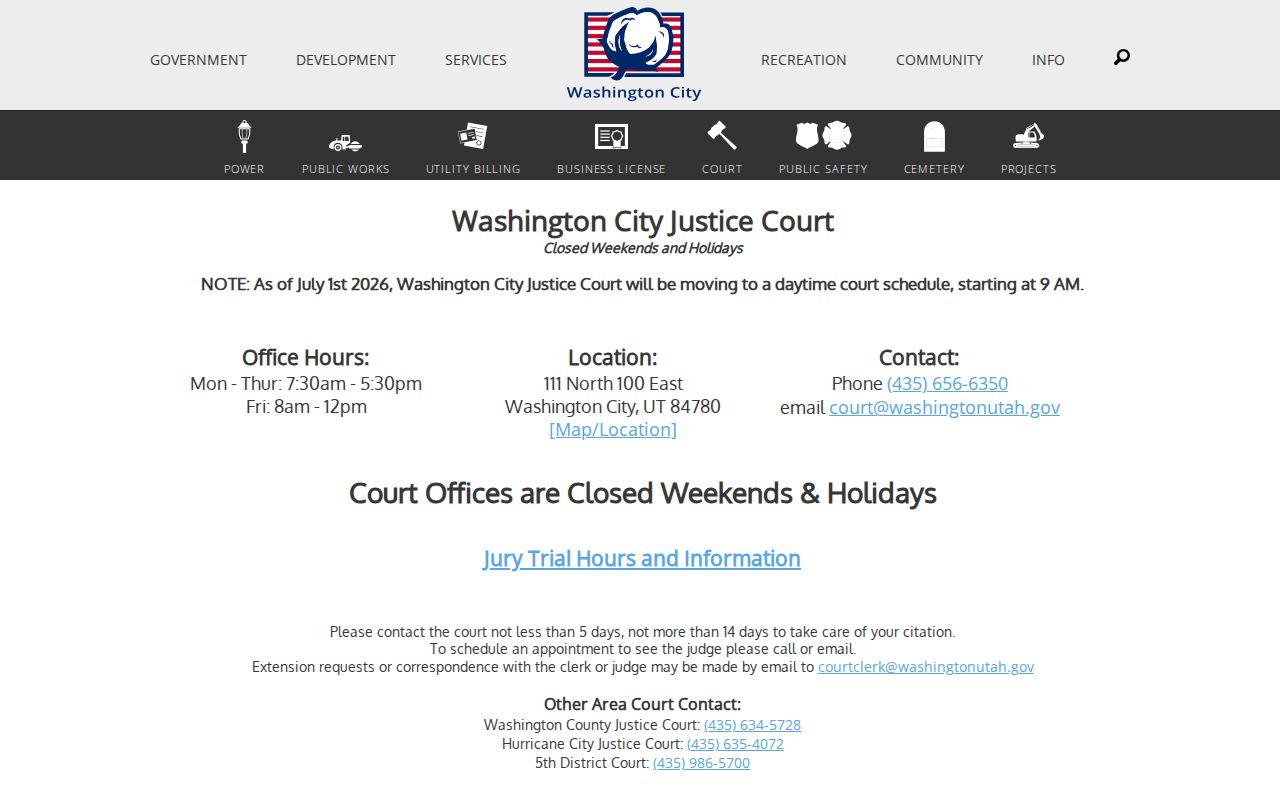
The Washington court page should be checked for its current counter and contact details. Utah Courts Xchange remains the statewide public case-information route, while MyCase is for parties in supported Washington cases.
| Court Name | Washington City Justice Court |
|---|---|
| Case Types Heard | Assigned justice-court matters, including lower-level city or state charges and traffic matters |
| Case Lookup Channel | Utah Courts Xchange, the official city court page, or the court counter and phone fallback |
| What the Docket Shows | Case number, filed charge, events, status, disposition, judgment, and available document links |
| Copies & Fees | Ask the court holding the file about inspection, available electronic documents, and current copy charges |
Washington Case Records in Xchange
Utah Courts Xchange covers public district and justice court information, not Washington police reports. Select both court jurisdictions and narrow the search to Washington County. A case number is useful, but it is not unique statewide. A name search should be checked against the court, filing date, birth date where lawfully shown, charges, and event history.
| Search field | Best use | Caution |
|---|---|---|
| Jurisdiction | Select district, justice, or both | A single level can miss part of the record |
| Search scope | Choose Washington County or a named court | “Washington” can refer to several things |
| Case number | Find a known filing | Numbers are not unique statewide |
| Name and birth date | Separate common-name results | Confirm identity from the whole docket |
| Date range | Narrow a broad result set | Filing may follow the arrest date |
MyCase is a free option for a party to a supported case, but it is not a general public search. If an expected city or justice matter does not appear, contact the court identified on the citation. Sealed, expunged, and juvenile cases are excluded from public Xchange results.
Where Washington Records Go
A Washington incident can create records in sequence, yet each office keeps its own version. The police report can exist before booking. A booking can appear before a prosecutor files a charge. Court history develops as hearings, pleas, rulings, and sentencing entries are added. BCI repository data depends on fingerprint and disposition reporting, so it is not the same as a live court docket.
Record flow: Washington City Police › Washington County Courts › Utah Department of Public Safety, Bureau of Criminal Identification
Recent Washington activity is best checked with the Washington or county custodian closest to the event. A mature Washington case belongs with the court. A person reviewing their own statewide Utah history should use BCI Right of Access with identity verification and fingerprints.
Correcting Washington Criminal Records
Send a claimed error to the office that created the inaccurate layer. Washington City Police can review its report. The court clerk handles docket data. BCI provides its repository challenge process. Utah Department of Corrections handles its own custody or supervision status. A disposition document can help show why an arrest allegation and the final court outcome do not match.
A Washington correction is not expungement. Correction addresses inaccurate or incomplete data. Expungement is legal relief under Utah law and follows a separate statutory process. A Washington clerk cannot alter a judicial disposition, and a court-search service cannot rewrite the Washington police source report.
Washington Registry Record Jurisdiction
Registry duties also follow jurisdiction. Under Utah Code §53-29-304, a registrant in Washington police jurisdiction who is not under Utah Department of Corrections supervision generally reports through the jurisdictional law-enforcement agency. A person on probation or parole through UDC reports through Adult Probation and Parole. Public searches belong in the statewide Utah Sex and Kidnap Offender Registry rather than an assumed city spreadsheet.
Report a suspected address or status issue to the proper agency. Do not confront a listed person. The registry is a public-safety tool with its own rules, and it is not a substitute for the police report, court judgment, or a person's BCI self-review.
Public Access Rules in Washington
Utah's Government Records Access and Management Act classifies government records as public, private, controlled, protected, or otherwise restricted. Washington City may release a public part while redacting protected victim, juvenile, safety, or active-investigation details. A requester seeking their own private record may have a different access path from the general public. Ask for segregable public portions when a full file cannot be released.
Court records follow Utah judiciary access rules. A police GRAMA request does not compel a court clerk to provide the court file, and Xchange does not reveal sealed, expunged, or juvenile matters. Each custodian applies the rules to the record it holds.
Key Statutes:
Utah Code §63G-2-201 establishes the right to inspect public records, subject to lawful limits.
Utah Code §63G-2-202 sets access rules for private, controlled, and protected records.
Utah Code §63G-2-203 governs request procedures and agency responses.
Utah Code §53-10-108 limits criminal-history dissemination and supports subject access through BCI.